Help for a Reactive or Aggressive Dog in Chandler
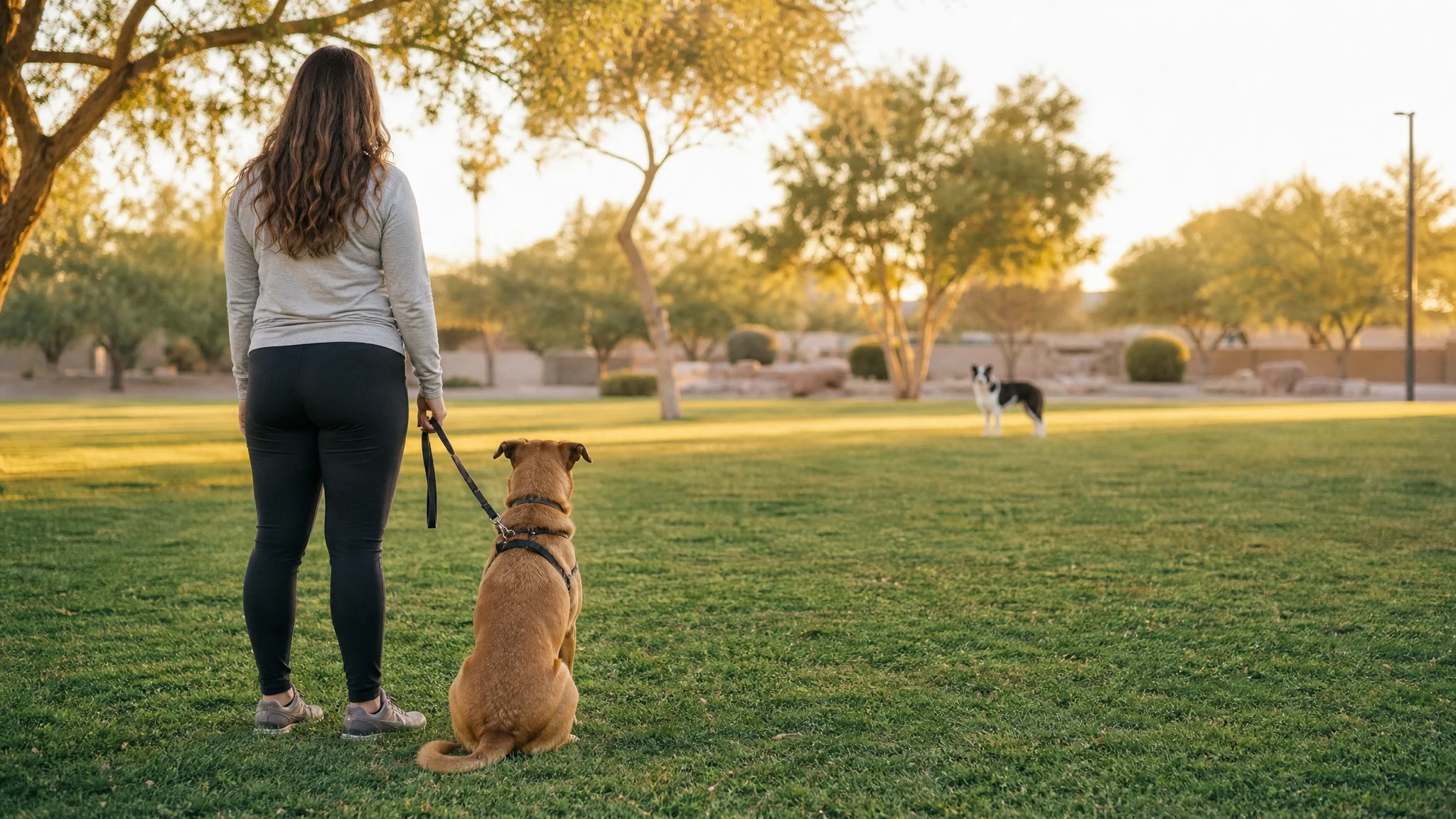
General training information. For aggression, sudden behavior changes or health concerns, see your veterinarian first.
If your dog lunges, barks or growls at other dogs, strangers or bikes, you are not alone, and you did not fail. Many Chandler owners deal with this on neighborhood walks, around park gates and at the vet's door. This guide explains what reactivity and aggression are, how to keep everyone safe, and how reward-based reactive dog training works in practice.
It also covers when to call a veterinarian, what Arizona law says about bites, and where to look for local professional help.
What reactivity and aggression actually are
A reactive dog overreacts to a trigger. The trigger might be another dog, a person, a skateboard or a car. The reaction is usually barking, lunging, spinning or freezing. Most reactive dogs are scared, frustrated or overexcited, not "dominant" or "bad."
Aggression is behavior meant to increase distance or cause harm. It includes growling, snarling, snapping and biting. A reactive dog can become aggressive if the trigger gets too close and the dog feels it has no other way out. The two overlap, but they are not the same thing.
Why it matters: the plan is similar, but the risk is different. Reactivity is mostly a management and training project. Aggression toward people needs professional help, and we cover that below.
Safety first, before any training
Training only works if nobody gets hurt while you do it. Set up safety before you start.
- Know the leash rule. Maricopa County Animal Care and Control says a dog off the owner's property must be on a leash of no more than six feet and under the owner's control. A dog not on a leash is considered "at large." Check the Chandler City Code or the city directly for the exact local wording.
- Skip the dog park for now. The City of Chandler's dog park rules say dogs must be leashed until inside the fenced area, must be under voice control, and that dogs in season are not allowed. A reactive dog in a gate crowd is a common recipe for a fight. Wait until your dog is much calmer around other dogs.
- Use distance as your main tool. More space means a calmer dog and a dog that can learn.
- Keep your dog licensed and vaccinated. Maricopa County requires dogs over three months old to be licensed, and a current rabies vaccination is required to license a dog. Call Maricopa County Animal Care and Control at 602-506-7387 for current fees and details.
- Protect visitors and children. Use a gate, a crate or a closed door when guests come over. Never leave a dog with a bite history alone with children.
Materials you will need
- A flat collar or a well-fitted harness, and a standard leash of six feet or less (not a retractable leash).
- Small, soft, high-value treats your dog loves, cut pea-size. Cooked chicken or cheese cubes are common choices if your dog tolerates them.
- A treat pouch so rewards come out fast.
- A well-fitted basket muzzle, introduced slowly with treats, if your dog has bitten or may bite. A muzzle is a safety tool, not a punishment.
- A visual barrier such as a baby gate, window film or a freestanding screen for home.
- A notebook or phone notes to log triggers, distances and reactions.
- A water bottle and a plan for cooler walking times. KJZZ, reporting advice from Mesa Animal Control, says to check pavement before walks and walk dogs in the cooler parts of the day. Summer heat makes any dog edgier, so an early walk helps training too.
Why punishment makes it worse
The American Veterinary Society of Animal Behavior (AVSAB) recommends reward-based training and advises against punishment-based methods for behavior problems. Punishment can suppress the warning signs (the growl, the stiff body) without fixing the fear underneath. A dog that has learned not to growl may bite with less warning.
Please avoid shock, prong and choke collars, yanking the leash, yelling, alpha rolls, scruffing and "dominance" methods. They add stress and pain to a moment when your dog is already overwhelmed. They can also teach your dog that the trigger predicts something bad, which is the opposite of what you want.
Step-by-step: a basic reactive dog training plan
This plan uses two ideas. Desensitization means exposing your dog to a trigger at a level so low it causes no reaction. Counter-conditioning means pairing that trigger with something great, like food, so the feeling about it slowly changes from "worry" to "good things happen."
Step 1: Visit your veterinarian first
Pain, thyroid problems, ear or skin trouble and other medical issues can cause or worsen reactivity. Book an exam before you assume it is only behavior. Tell the vet exactly what your dog does, how often and when it started. Video from your phone helps.
Step 2: Learn your dog's body language
Watch for early signs: a hard stare, a closed mouth, stiff posture, lip licking, whale eye (white showing around the eyes), a lifted paw or a sudden stop. Your goal is to act at these signs, before the barking and lunging. Write down what your dog does first.
Step 3: Find your dog's threshold distance
The threshold is the distance at which your dog notices the trigger but can still take a treat and think. If your dog explodes at 50 feet, then 80 feet may be your starting point. That is fine. Progress is measured by how comfortable your dog is, not how close you get.
Step 4: Start the "see trigger, get treat" game
When your dog sees the trigger at a comfortable distance, say a cheerful "yes" and feed several treats in a row. When the trigger leaves, the treats stop. Over repetitions, your dog may start looking at you when a trigger appears. That look is the sign it is working.
Step 5: Practice in short, quiet sessions
Keep sessions to five or ten minutes. Choose places and times with few surprises, such as a wide, quiet street or an empty parking lot at off-peak hours. A helper with a calm, leashed dog at a distance can be useful, but only with a friend who understands the plan. Do not use strangers' dogs or random greetings.
Step 6: Teach an easy exit
Practice a cheerful "let's go" and a U-turn with treats at home first, then on walks. Being able to leave smoothly gives your dog confidence, and gives you a plan when someone appears around a corner.
Step 7: Add difficulty very slowly
Only when your dog is relaxed for several sessions in a row, reduce the distance by a small step. If your dog reacts, you moved too fast. Go back to the last comfortable distance. Slow and boring is the pace that works.
Step 8: Manage the rest of the day
Every outburst rehearses the behavior. Use window film, close blinds, change walk routes, or walk at quieter hours. Give your dog sniffing walks, food puzzles and chew time, because a dog that is mentally tired and unstressed has an easier time learning.
Tips that help
- Reward calm behavior generously, even small moments like a glance away from the trigger.
- Stay relaxed and breathe. Dogs read tension on the leash.
- Keep treats better than usual. Dry biscuits rarely compete with a barking dog across the street.
- Train at the same quiet location several times before changing venues.
- Track progress weekly, not daily. Reactivity improves in a zigzag, not a straight line.
- Tell your household the plan so everyone handles the dog the same way.
Common mistakes to avoid
- Going too close, too soon. This is the number one reason plans stall.
- Letting "friendly" dogs approach. Say no politely. A surprise greeting can undo weeks of work.
- Correcting the growl. A growl is information. Respect it and increase distance.
- Flooding. Forcing a scared dog to "face it" tends to deepen fear.
- Skipping the vet visit. Behavior and health are linked.
- Using the dog park as therapy. It is usually too much, too fast.
When to see a veterinarian or a veterinary behaviorist
Call your veterinarian promptly if the behavior is sudden, if your dog seems to be in pain, or if it is getting worse quickly. If your dog is hurt or in a fight, go to a veterinarian right away.
A veterinary behaviorist is a veterinarian with advanced training in behavior, and can consider both medical causes and, where appropriate, medication alongside training. Ask your regular veterinarian whether a referral makes sense, especially if your dog has bitten, if the problem is severe, or if training has not helped after steady effort.
If your dog shows aggression toward people, including growling, snapping or biting, do not wait. See a veterinarian and work with a certified behavior professional. Keep your dog managed with gates, leashes and a muzzle if needed until you have a plan. Do not try to fix this alone.
Chandler's dangerous dog rules and bite reporting
I could not confirm the exact Chandler City Code wording on dangerous dogs, so check with the City of Chandler or Maricopa County Animal Care and Control for the local rule. What I can point to is Arizona state law.
- Arizona law holds an owner liable for dog-bite damages.
- Arizona Revised Statutes 11-1025 defines what counts as a "vicious" dog.
- Under ARS 11-1014, a dog that bites must be reported to the county enforcement agent. An unvaccinated biting dog is quarantined for at least ten days. A vaccinated biting dog may be quarantined at home if the county enforcement agent approves.
Keeping your dog's rabies vaccine current and your dog contained and leashed protects you and your dog if something goes wrong. If you are worried about a bite risk, that is another reason to bring in a professional early.
Local help in and around Chandler
Not every trainer works with reactive dogs, so ask directly about their experience, their methods and whether they use only reward-based techniques. The professionals below are listed with the credentials and service areas shown on their own pages or on the CCPDT directory. This is not a ranking or a recommendation. Confirm current availability and fit yourself.
- Julie Yvonne Davis, Kaleidoscope Dog Services LLC. Listed in the CCPDT directory as CPDT-KA (the profile also lists ABCSDT). Based in Gilbert and serves Gilbert, Queen Creek, Mesa and Chandler. Website: kaleidoscopedogservices.com.
- Ashley Theis, See Ash Go Dog Training. Lists CPDT-KA, ABCDT and ABCSDT, plus AKC CGC Approved Evaluator status and APDT membership. Based in Queen Creek and serves surrounding cities. Website: seeashgo.com.
- East Valley K9 Services. The page lists CPDT-KA and AKC Canine Good Citizen Certified Evaluator among its qualifications. It is based in Mesa, and its services page says classes are held in the Chandler area and that it serves Mesa, Chandler and Phoenix. Website: eastvalleyk9.com.
- Sharon Witherspoon. Listed in a trainer directory as CPDT-KA and based in Gilbert. Profile: dogtrainerlocator.com.
I do not have a named veterinary behaviorist or certified behavior consultant to list for Chandler. Your veterinarian is the best first stop for a referral, and the CCPDT directory is a place to look for certified trainers. For a wider look at options and what to expect from classes and private sessions, see our guide to dog training in Chandler, where to train and what it costs.
When you call anyone, ask these questions:
- What methods and tools do you use, and do you use any aversive tools?
- Have you worked with reactive or aggressive dogs before?
- Will you coordinate with my veterinarian?
- How do you handle safety during sessions?
A good professional will welcome these questions and explain the plan in plain words.
What results to expect
Every dog is different, so no one can promise an outcome. Many owners find that consistent, reward-based work may lead to a calmer dog, shorter reactions and more recovery time between triggers. Some dogs improve a lot over several months. Others improve more slowly, and some always need management.
A realistic goal is a dog that is safer and more comfortable, and an owner who can read the signs and step in early. Count small wins: a glance at you, a quicker recovery, a trigger passed at a closer distance than last month.
A few last words for Chandler owners
Reactivity is common, and it is workable. Start with a vet check, build distance into your walks, keep rewards flowing and ask for help early. If your dog has bitten or you feel unsafe, bring in a veterinarian and a certified behavior professional right away.
Sources
- Maricopa County Animal Care and Control, Our Field Team
- Maricopa County, Animal Care and Control licensing FAQ
- Maricopa County, Animal Care and Control FAQ
- Arizona Revised Statutes 11-1014
- City of Chandler, Dog Parks
- KJZZ, Tips to keep pets safe in Arizona's extreme heat
- CCPDT certified dog trainer directory profile