Off-Leash Dog Parks in Chandler and How to Train for Them
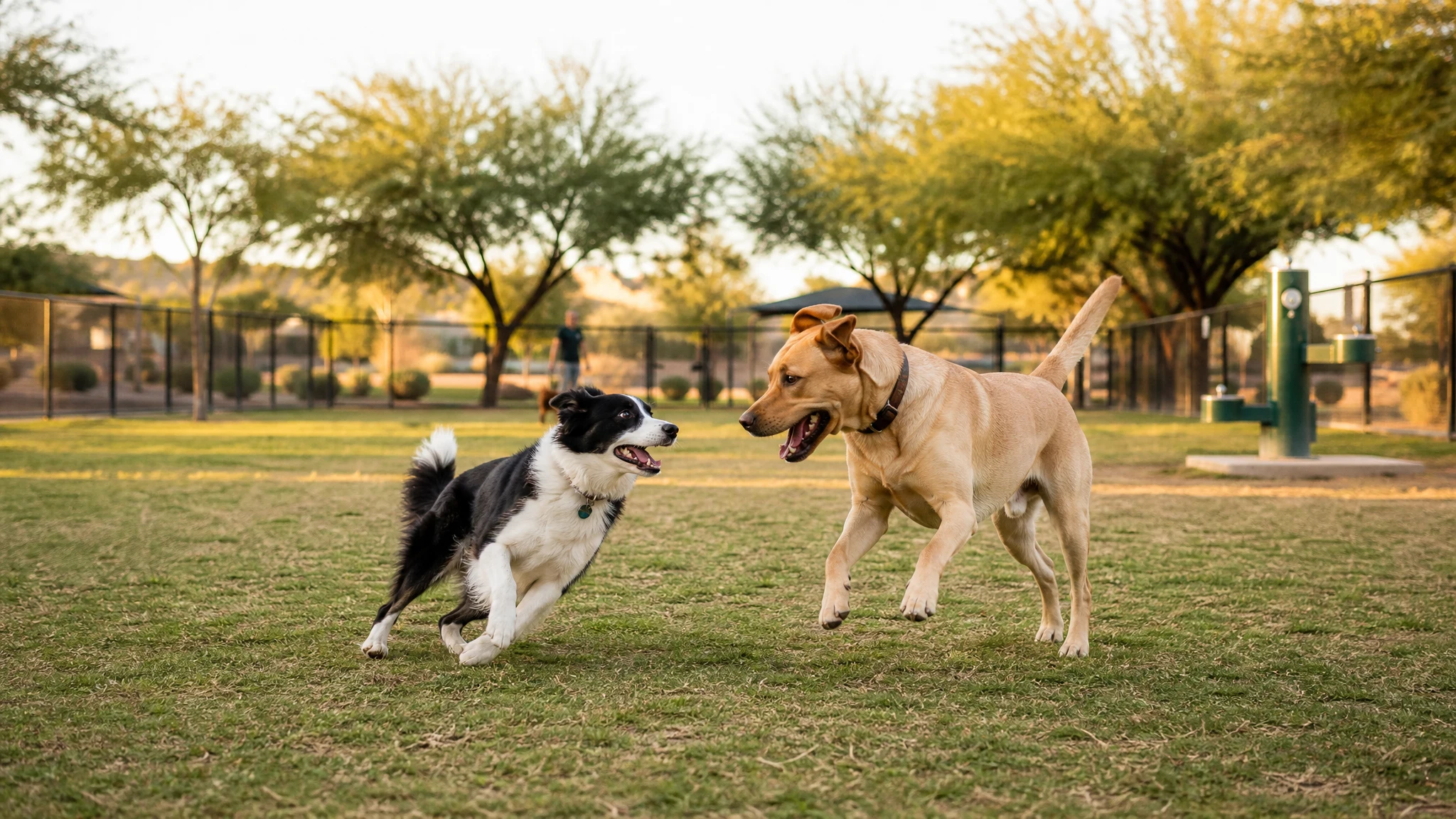
General training information. For aggression, sudden behavior changes or health concerns, see your veterinarian first.
A fenced dog park can be a great outlet for a social, well-mannered dog. It can also be overwhelming for a dog who has not learned to come when called or to settle around strangers. This guide covers the dog parks in Chandler, what the city posts about their rules, and a step-by-step plan to get your dog ready before the first visit.
If you are looking for an off-leash dog park near Chandler, start with the four city parks below. Then use the training steps to decide when your dog is ready.
Dog Parks in Chandler: Locations, Hours and Rules
The City of Chandler lists four dog parks on its parks guide. Hours and maintenance closures can change, so check the city's dog parks page before you go.
| Park | Location | Hours and closures (per the City of Chandler) |
|---|---|---|
| Paseo Vista Recreation Area dog park | 3850 S. McQueen Rd., north of Ocotillo Rd., west side of McQueen Rd. | 6 a.m. to 10:30 p.m. Closed Thursday 6 a.m. to 2:30 p.m. for maintenance. |
| Shawnee Park dog park | 1400 W. Mesquite, north of Warner Rd., between Alma School and Dobson roads | Mon and Wed to Sat 6 a.m. to 8 p.m.; Sun 9 a.m. to 8 p.m. Closed all day Tuesday for maintenance. |
| Snedigar Sportsplex dog park | 4500 S. Basha Rd., Alma School Rd., south of Ocotillo Rd. | 6 a.m. to 10:30 p.m. Closed Wednesday 6 a.m. to 2:30 p.m. for maintenance. |
| Nozomi Park dog park (formerly West Chandler Park) | 250 S. Kyrene Rd., south of Chandler Blvd. | 6 a.m. to 10:30 p.m. Closed Monday 6 a.m. to 2:30 p.m. for maintenance. |
The city page listed no fee for any of these parks. It also carried a notice that the small-dog section at Snedigar Sportsplex was closed for fence repair while the large section stayed open. That may have changed, so confirm with the city before you drive over.
The posted rules
The City of Chandler's dog park rules include the following:
- Dogs must be licensed and vaccinated.
- Dogs stay on a leash until they are inside the fenced area.
- Dogs must be under voice control.
- Puppies must be older than four months.
- Dogs in season are not allowed.
- The city page lists a maximum of three dogs per owner per visit.
- No children under 12.
That voice control rule is the heart of this article. The park expects you to be able to call your dog away from trouble. That is a skill you build at home first.
License, Vaccines and Leash Rules Before You Go
Maricopa County Animal Care and Control says dogs over three months old must be licensed in the county, which issues the licenses. Its licensing FAQ lists these fees:
- $22 for a spayed or neutered dog, with a $3 discount per license completed online.
- $55 for an unaltered dog, with a $5 discount per license completed online.
- $10 per spayed or neutered dog for owners 65 or older.
Fees can change, so confirm them with the county at 602-506-7387. A current rabies vaccination is required to get or renew a license, and the county FAQ notes that a veterinarian or certified rabies vaccinator must give it under Arizona law (ARS 11-1010).
On the leash, Maricopa County Animal Care and Control describes a dog off the owner's property as needing to be on a leash of no more than six feet and under the owner's control. A dog without one is considered "at large." For the exact Chandler wording, check the City of Chandler directly, since the county's description is not the same as the city code.
What You Need Before You Start Training
- A flat collar or a well-fitted harness. Skip prong, choke and shock collars. They do not fit a reward-based plan, and the American Veterinary Society of Animal Behavior (AVSAB) recommends reward-based training.
- A 6-foot leash for daily walks and the park entrance.
- A 15 to 30 foot lightweight long line for practicing recall outdoors.
- Small, soft treats your dog loves, cut into pea-sized pieces. Keep a few special ones, like plain cooked chicken, for the hardest practice.
- A treat pouch so rewards are quick.
- A quiet space at home, then a quiet outdoor space with few distractions.
- Fresh water and a collapsible bowl.
- Your dog's license and rabies paperwork, so you know both are current.
Step-by-Step: Train Your Dog for the Dog Park
Work through these in order. Short sessions of five minutes or so, once or twice a day, usually work better than one long session. Move to the next step only when your dog does the current one reliably.
Step 1: Build a reliable recall
Pick a word, such as "here," and use it only for coming to you. Never use it before something your dog dislikes.
- Indoors, say the word once in a cheerful voice when your dog is a few feet away. When they arrive, give a treat and praise.
- Add distance, then move to another room, always rewarding the arrival.
- Take it to your yard on the long line. Call when your dog is mildly distracted, and reward generously.
- Practice in a quiet park or open space, still on the long line.
If your dog does not come, do not chase or scold. Make yourself more interesting by backing up or crouching, and reward when they arrive. A dog who gets punished for coming learns that coming is risky.
Step 2: Teach check-ins
A check-in is when your dog looks at you on their own. It tells you they are tuned in, even with distractions around.
- On a walk, reward every time your dog glances at you, even by accident.
- Wait for the glance instead of asking for it. Mark it with a cheerful "yes!" and treat.
- Practice in more interesting places, such as outside the fence at a park with other dogs in view.
Over time, many dogs start checking in more often. A dog who checks in is much easier to call away from trouble.
Step 3: Practice a calm leash entrance
Chandler requires dogs to stay leashed until they are inside the fence. Bursting through a gate while excited is a common source of scuffles.
- Practice sit-and-wait at doorways and gates at home.
- At the park, stand outside the fence and watch from a distance. Reward calm behavior and check-ins.
- Enter only when your dog is calm and looking at you. Unclip the leash inside the fence, not in the entry area.
If your dog is too wound up to settle, walk away and try another day. Nothing is lost by waiting.
Step 4: Learn to read play
You are your dog's advocate, so it helps to know what healthy play looks like. Signs that play is going well often include:
- Loose, wiggly bodies and relaxed faces.
- Taking turns chasing and being chased.
- Play bows and short pauses.
- Dogs who return for more after a break.
Signs it may be time to step in include:
- A dog who is hiding, tucking their tail or trying to leave.
- Stiff bodies, hard stares or raised hackles.
- One dog being pinned, cornered or chased by several others.
- Play that gets louder and tenser instead of looser.
When in doubt, call your dog away calmly, reward the recall, and give everyone a break. Interrupting early is much easier than fixing a fight.
Step 5: Practice leaving calmly
Leaving is a skill, too. A dog who only leaves the park by being dragged may begin to avoid coming when called.
- Do a few recalls during each visit, then send your dog back to play. That way, coming to you does not always mean the fun ends.
- Call your dog before they are too tired or overstimulated.
- Clip the leash on, hand over a treat, and walk out calmly.
- End on a good note, not after a scuffle.
Tips for Your First Visits
- Go at a quiet time of day. The parks open early, and fewer dogs often means an easier introduction.
- Start with short visits of about 10 minutes and see how your dog responds.
- Stay off your phone. Watching your dog is your job at the park.
- Mind the heat. KJZZ reported Mesa Animal Control's advice to check pavement before walks and to walk dogs in the cooler parts of the day. Booties can help but do not guarantee safety. Mesa is a neighbor of Chandler, and this is regional advice for the Phoenix area.
- Bring water, and take breaks in the shade when you can.
- If your dog is hurt or seems unwell after a visit, call a veterinarian.
Common Mistakes to Avoid
- Skipping the training. The posted rule is voice control. Do not treat the park as the place to learn it.
- Calling your dog only to leave. If every recall ends the fun, recall gets weaker.
- Letting a rude dog "work it out." Step in early, calmly.
- Bringing a dog in season. The city rules do not allow it.
- Bringing young children. The city rules say no children under 12.
- Bringing a puppy too soon. The city rules say older than four months. Check with your veterinarian about when your puppy's vaccines are complete.
- Using punishment tools. Shock, prong and choke collars, alpha rolls and scruffing can raise fear and stress. They are not part of a reward-based plan.
When a Dog Park Is Not Right for Your Dog
Many good dogs do not enjoy dog parks, and that is fine. A dog park may not be a good fit if your dog:
- Is fearful, shy or tends to hide or freeze around other dogs.
- Guards toys, treats, or you.
- Does not come when called, even in quiet places.
- Is a puppy under four months, or not fully vaccinated or licensed.
- Is an unspayed female in season.
- Gets overly rough or cannot settle after play begins.
You still have good options: leashed walks with a friend's dog, a long line in an open space, or training games at home. A tired, mentally busy dog does not need a dog park.
If your dog shows aggression toward people, do not use the park to work on it. See your veterinarian first, since pain and illness can change behavior. Then work with a certified behavior professional. For any medical or behavior emergency, call a veterinarian right away.
Arizona law also matters if a bite occurs. Under ARS 11-1014, a dog that bites must be reported to the county enforcement agent, and an unvaccinated biting dog is quarantined for at least ten days. A vaccinated biting dog may be quarantined at home if the county enforcement agent approves.
Getting Help With Training
A trainer can help with recall and park manners, especially if your dog struggles with distractions. Our guide to dog training in Chandler, where to train and what it costs covers options and published prices.
The CCPDT directory lists certified trainers. One listed trainer, Julie Yvonne Davis of Kaleidoscope Dog Services LLC in Gilbert, holds a CPDT-KA credential and, per the directory, serves Gilbert, Queen Creek, Mesa and Chandler. Contact any trainer directly to ask about methods, and look for reward-based training.
What Results to Expect
Every dog learns at a different pace. With regular, short practice, many dogs show a more reliable recall and more check-ins over several weeks. Busy places like dog parks usually take longer than quiet yards. Progress may be uneven, and some dogs do better with a trainer's help. A good plan is to be patient, keep rewarding, and decide based on how your dog actually behaves, not on a timeline.
Sources
- City of Chandler, Dog Parks
- Maricopa County Animal Care and Control, licensing FAQ
- Maricopa County Animal Care and Control, FAQ (rabies and licensing)
- Maricopa County Animal Care and Control, Our Field Team
- Arizona Revised Statutes 11-1014
- KJZZ, Tips to keep pets safe in Arizona's extreme heat
- CCPDT certified dog trainer directory, Julie Yvonne Davis